
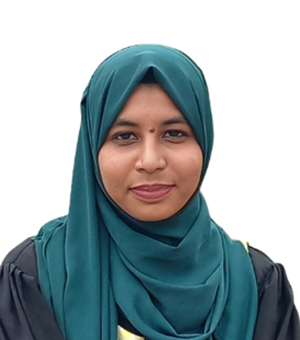
Jannatul Ferdous

Lecturer
Biochemistry and Biotechnology
Email: jannatuldbbtech@ustc.ac.bd

Profile

Jannatul Ferdous was born and raised in Sitakunda, Bangladesh. She earned both her B.Sc. (Hons) and M.Sc. in Genetic Engineering and Biotechnology from the University of Chittagong, with a thesis on antimicrobial resistance and the gut-microbiome of coastal fish. After graduation she served as Lab Manager and Research Assistant at the Disease Biology & Molecular Epidemiology (DBME) laboratory, University of Chittagong, leading metagenomic and AMR surveillance projects. Since July,2025 she has been a Lecturer in the Department of Biochemistry and Biotechnology, University of Science & Technology Chittagong (USTC). Her current work focuses on infectious-disease genomics, antimicrobial resistance, metagenomics and molecular techniques.

Education

  • “Master of Science (M.S.)
    Genetic Engineering and Biotechnology, University of Chittagong, Chattogram, Bangladesh
    2021 – 2022
    Thesis: ‘Identification of the Antimicrobial Resistance and Gut Microbiome of Fishes Collected from the Southeast Coast of Bangladesh’
  • Bachelor of Science, B.Sc.(Honours)
    Genetic Engineering and Biotechnology, University of Chittagong, Chattogram, Bangladesh
    2016 – 2020″

Program Affiliated

  • Genetic Engineering and Biotechnology

Areas of Interest

  • Antimicrobial resistance
  • Microbiological lab techniques
  • C-PCR
  • qPCR
  • RT-PCR
  • RFLP
  • Metagenomics
  • Next generation sequencing

Courses Taught

  • Bioorganic Chemistry-II (BB-122)
  • Enzymology-II (BB-211)
  • Molecular Genetics (BB-323)

Journals & Articles

  • Afroza Akter Tanni, Farjana Sharmen, Kallyan Chakma, Farhana Yasmin, Al-Shahriar Akash, Md. Ashikur Alim Akash, Sumaiya Hafiz Riana, Sajia Afrin, Jannatul Ferdous, Nahid Sultana, Sanjoy Kanti Biswas, S. M. Rafiqul Islam, Adnan Mannan. Microbiology Resource Announcements: American Society of Microbiology; June 2024
    Whole-genome sequencing of 30 clinical Klebsiella pneumoniae from Chattogram, Bangladesh (2022) showed 77 % were multidrug-resistant; the collection carried a rich mobilome of blaCTX-M-15, blaNDM-1, armA, tet(A), mphA and mutations in gyrA/parC. Phylogenomics revealed both globally disseminated high-risk clones (ST11, ST15, ST147, ST231) and unique local lineages, with plasmid backbones (IncFII, IncX3, ColKP3) driving carbapenem and aminoglycoside resistance. The data warned of an expanding, highly mobile resistome in this region and provide a benchmark for future surveillance. https://journals.asm.org/doi/10.1128/mra.00442-24